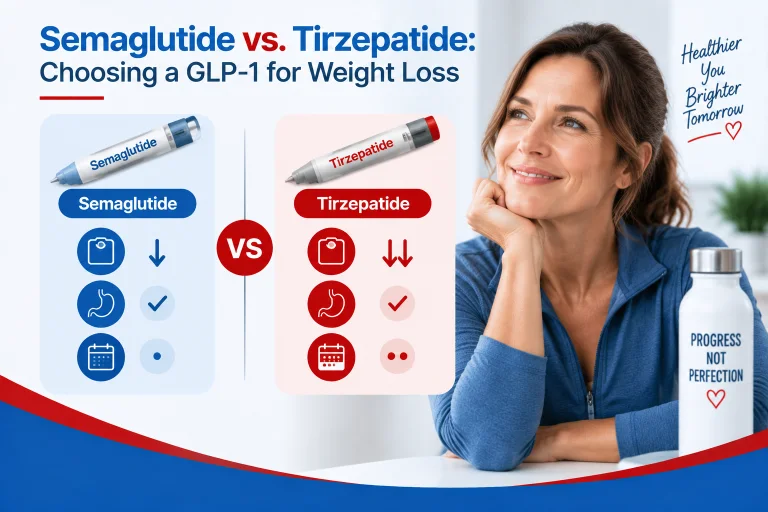
Quick answer: Semaglutide and tirzepatide are both injectable medications that reduce appetite and support weight loss, but they work on slightly different pathways. Tirzepatide acts on two hormone receptors while semaglutide acts on one. Neither is automatically better for everyone. The right choice depends on your health history, your goals, and how you respond, decided with a medical provider.
If you have been researching medical weight loss, you have run into these two names, and probably a lot of confusing claims about them. Semaglutide and tirzepatide are the medications behind most of the GLP-1 conversation right now. They can be genuinely effective tools, but they are prescription medications that belong in a supervised program, not a quick fix you order and forget. Here is a clear, honest comparison and how we decide which one fits at Mission Wellness & Aesthetics.
What these medications actually do
Both semaglutide and tirzepatide are based on gut hormones your body already makes after you eat. They slow how quickly food leaves your stomach, signal fullness to your brain, and turn down appetite. The result for most people is that eating less feels far more manageable, because the constant hunger and food noise quiet down. That is the mechanism behind the weight loss, and it is why these medications have changed the conversation around obesity treatment.
The key thing to understand is that these medications reduce appetite. They do not burn fat on their own. Your actual results still depend on what you eat, and specifically on getting enough protein and staying active so the weight you lose is fat rather than muscle. That is exactly why a supervised program matters more than the drug name. Two people can take the identical medication at the identical dose and see very different results, and the difference usually comes down to what happens around the medication, the food, the protein, the movement, and the follow-up. The prescription is a tool. The program is what makes the tool work.
The core difference between them
Here is the distinction in plain terms.
Semaglutide
Semaglutide works on a single pathway, the GLP-1 receptor. It is well established, widely used, and effective for many people at reducing appetite and supporting weight loss.
Tirzepatide
Tirzepatide works on two pathways, GLP-1 and a second one called GIP. For many people that dual action curbs appetite a bit more, which is part of why it has drawn so much attention. Because it is doing more, some people also need a careful, gradual dose increase to stay comfortable.
Neither of these facts means one is simply better. They mean the two medications have different profiles, and the right fit depends on the person taking it.
How we decide which one fits you
This is where a real program earns its keep. Choosing between these medications is not about which one is trending. Your provider looks at several things together.
Your health history
Certain conditions and medications affect which option is appropriate or whether either is. This review comes first, always, and it is why these are prescription medications rather than something to source on your own.
Your goals and starting point
How much you are looking to lose, and your overall metabolic picture, factor into the recommendation.
Tolerance and side effects
Both medications can cause nausea, constipation, or other stomach effects, especially as the dose increases. How you tolerate a medication is a real part of choosing and adjusting it, which is why doses start low and step up slowly.
Your response over time
Sometimes the answer becomes clear only after you start. If one medication is not delivering or is not tolerated well, your provider can adjust the dose or reconsider the approach. That ongoing management is the point of a supervised plan.
Why physician-supervised matters
You can find these medications advertised everywhere, often with no real oversight. The problem is that weight loss done poorly can cost you muscle, leave underlying issues untreated, and set you up to regain everything when you stop. A supervised program addresses that. At Mission Wellness & Aesthetics, medical weight loss is built around an evaluation, appropriate lab work, and a plan that protects your muscle through adequate protein and activity, with regular check-ins to adjust as you go. Amanda Baker, PA-C, brings close to two decades of medical experience to that oversight.
We also know your labs might turn up something driving the weight in the first place, like a thyroid issue or insulin resistance, which is another reason guessing on your own is a mistake. Catching one of those can change the whole plan, and sometimes treating it is what finally makes weight loss possible after years of frustration. That is not something an online prescription mill is looking for on your behalf.

How a supervised program actually works
It helps to know what you are signing up for. A medical weight loss program usually starts with a visit that covers your health history, your goals, and lab work when it is useful, so your provider can rule out or address anything driving the weight and confirm a medication is appropriate. If a GLP-1 fits, you start at a low dose and step up gradually to limit side effects, and you learn how to self-administer the weekly injection. From there, regular check-ins track your progress, manage any side effects, and adjust the plan, including attention to protein and activity so you lose fat while protecting muscle. When you reach your goal, the focus shifts to maintenance. That arc, evaluation to titration to maintenance, is what separates a real program from simply handing someone a prescription.
Common myths worth clearing up
A few ideas keep tripping people up. The first is that these medications are an easy button that works no matter what you eat. They quiet appetite, but nutrition and activity still decide whether the weight you lose is fat or muscle. The second is that a higher dose is always better. Dosing is individual, and pushing it too fast usually just means more nausea, not more results. The third is that you can safely source these medications without oversight. Skipping the evaluation means missing conditions that affect your safety and your results, and losing the monitoring that keeps the plan working. Understanding these upfront makes for a smoother, safer experience and more realistic expectations.
In-clinic and virtual options
One of the things that makes staying on plan realistic is flexibility. Mission Wellness & Aesthetics offers medical weight loss both in the clinic and through virtual visits, so your follow-ups can fit your schedule rather than forcing a drive every time. Some people prefer coming in, others do better checking in virtually between in-person visits, and many mix the two. Your provider will explain what your plan needs and how much can be handled virtually, so distance or a busy week does not derail your progress. For patients around Hampstead and the wider Topsail and Wilmington area, that flexibility is often what keeps the plan going.